
From 1st June 2026, the Lancashire and South Cumbria Eye Care Navigation Service (ECNS) is launching, introducing a new referral endpoint for routine GOS18 referrals on the IT platform, OPERA.
If you missed the event, please see below for the link to the recording of the session and the presentation slides:
Lancashire and South Cumbria Eye Care Navigation Service Launch Event Slides
Lancashire and South Cumbria Eye Care Navigation Service Launch Event Recording
What’s changing?
- Routine GOS18 referrals
- Select: “ROUTINE GOS18 REFERRALS ECNS – LANCS AND SC – NOT FOR CUES OR GERS” in OPERA
- Choosing any other routine endpoint will also automatically be redirected into ECNS for clinical triage
- Urgent GOS18 referrals
- Continue selecting a specific provider endpoint as usual
- These will be automatically redirected into ECNS for clinical triage
- Emergency referrals
- No change – continue to use existing local emergency pathways
- Referrals for community services (e.g. CUES, GERS, Low Vision Service).
- No change – continue referring to a named provider after a choice conversation
- Children’s referrals – Please choose named providers as normal.
As part of the rollout of the Eye Care Navigation Service (ECNS) in Lancashire and South Cumbria, all participating practices are required to use secure communication methods when sharing patient information.
We understand that some practices are not yet using the recommended IT platform, OPERA and may have different levels of access to secure email. Please follow the guidance below depending on your setup:
What you need to
If your practice:
- Is not using the IT platform, OPERA, and
- Does not have an nhs.net email address
You must register to use KnowBe4 (formerly Egress) as soon as possible to securely send and receive patient information.
Please find the link here –
KnowBe4 Switch | Authentication
Accessing Encrypted Emails – a Guide for non NHSmail users
If you already have an Egress log in, you can sign in using your existing log in details.
If your practice:
- Is not using the IT platform, OPERA, but
- Does have an nhs.net email address
You should send referrals securely via NHSmail to the ECNS hub at: cnech.pecservices@nhs.net
Why this is important
Using a secure, approved communication method is essential to:
- Protect patient confidentiality
- Meet NHS information governance requirements
- Ensure safe and timely delivery of the Eye Care Navigation Service
If you have any questions or require further support, please contact Primary Eyecare Services via email at hello@referral.support with ‘L&SC Eye Care Navigation Service’ in the subject header.
Any patients presenting with symptoms suggestive of wet AMD should be seen by a CUES practice in the first instance for triaging and OCT – if you are not registered for CUES please see the CUES tab for information on how to find a practice.
Westmorland General Hospital (part of University Hospitals of Morecambe Bay NHS Foundation trust) is involved in the management and treatment of wet AMD. In order for referrals to be accurately processed they should be sent urgently to the ECNS via Opera selecting URGENT – WET AMD – UNIVERSITY HOSPITAL MORECAMBE BAY as the end point.
If you are unable to use Opera or refer into CUES, please use this wet AMD referral form and follow the guidance above to send to the Eye Care Navigation Service. Practitioners are asked to use NHS.net email for referrals and flag the email as high priority and urgent.
Please note that any co-pathology (e.g. glaucoma) should be referred separately.
Patients with a suspected sub-macular haemorrhage may require vitreo-retinal intervention for the haemorrhage to be aspirated within a week. Patients with a suspected sub-macular haemorrhage should be referred to the emergency eye clinic at Barrow-in-Furness or Lancaster by selecting UHMB (RLI AND FGH) EMERGENCY REFERRALS from the referral module. They will be assessed and, if aspiration of the haemorrhage is required, listed directly at Lancashire Teaching Hospitals (LTHTR) Chorley site.
Westmorland General Hospital
Burton Road
Kendal
LA9 7RGTel: 01539 715250
Website:https://www.uhmb.nhs.uk/hospitals/westmorland-general-hospital
Guidelines for VR Referrals to LTHTR for community optometrists South Cumbria and Lancashire
Emergency Patients
All emergency patients (Retinal tears, retinal detachments, vitreous haemorrhages, submacular haemorrhages, sudden dislocation of IOL and sudden loss of vision) should be referred to local emergency eye department as per current practice. Patient’s will be assessed as an emergency locally and those deemed to require VR intervention will be referred on to LTHTR.
Full-Thickness Macular holes (FTMH)
Refer direct to LTHTR for all full thickness macular holes (with an accompanying OCT through the fovea if available).
Please include refraction where available.
These patients are normally suitable for direct listing for surgery via telephone consultation with a VR surgeon.
Epiretinal Membrane (ERM), Lamellar/Partial-Thickness macular holes and Vitreomacular traction (VMT)
The majority of these patients have good vision and/or are asymptomatic and so can be given an Amsler chart to monitor vision and do not need VR opinion or intervention.
If vision is reduced to 6/9 or less (0.2 logMAR) and patient has symptoms of worsening vision and/or significant distortion impacting on their daily life please refer to the Eye Care Navigation Service (with an accompanying OCT through the fovea if available).
Any general retinal pathology e.g. naevi, retinoschisis, macular schisis, white without pressure, lumps and bumps please refer to the Eye Care Navigation Service on a routine basis for a retinal opinion.
LTHTR does show as an end point to refer to in Opera as CHORLEY AND SOUTH RIBBLE HOSPITAL – LTHNFT – VITREORETINAL for patients with a Morecambe Bay GP. If you feel the patient requires VR intervention e.g. with a macular hole, then please do select this endpoint. The end point type is a “Request” / directly bookable endpoint. This means that the patient will receive a letter in the post with instructions on how to book their appointment at LTHTR. Only once the patient has done this will the referral pass through to LTHTR so please ensure you instruct the patient accordingly.
A copy of this letter will show on the patient record in Opera – once the referral has confirmed as having sent, please open the patient record and select “ERS_LETTER” at the top left. A copy can be downloaded and printed and given to the patient if you wish by selecting “Download documents” at the top left and clicking “ERS_LETTER”.
If you are unable to use Opera please use this Ophthalmology Referral Template in preference to any other format (eg. GOS18) and email to the ECNS hub at: cnech.pecservices@nhs.net, in pdf, word or jpeg format, using an NHS.net account. You will receive a confirmation email to indicate your referral is being processed or a return email advising the referral needs amending and resending.
Use of the above template is strongly recommended. It will assist the process of uploading the referrals to the NHS Electronic Referral System (eRS). Using different formats will slow down processing and increase opportunities for error and omissions. If you are unable to use the template, please ensure all the information requested is included in your referral.
NHS Numbers significantly improve speed and accuracy of referral processing, making it safer for our patients. While optical practices do not currently routinely collect NHS numbers, including them in the referral makes an enormous difference.
- www.nhs.uk/nhs-services/online-services/find-nhs-number – will instantly text the NHS number to a mobile phone
Please consider if your practice could collect and record NHS numbers as part of patient registration or booking procedures.
Referrals will be rejected if they are incomplete. The ECNS wish to work with optical practices to implement a safe and efficient system. Please be aware that it may be necessary to reject referrals if insufficient information is provided to enable accurate processing.
If you have any questions or require further support, please contact Primary Eyecare Services via email at hello@referral.support with ‘L&SC Eye Care Navigation Service’ in the subject header.
Royal Lancaster Infirmary
Ashton Road
Lancaster
Lancashire
LA1 4RPSwitchboard: 01524 65944
Mon – Fri: 9.00am – 5.30pm
Weekend: 9.30am – 3.00pmFurness General Hospital
Dalton Lane
Barrow-In-Furness
Cumbria
LA14 4LFSwitchboard: 01229 870870
Mon – Fri: 8.30am – 5.00pm
Weekend: ClosedCommunity Patient Contact Centre (CPCC)
CPCC
Westmorland General Hospital,
Burton Road
Kendal
LA9 7RGPhone: 01539 716998
Royal Lancaster Infirmary
Ashton Road
Lancaster
Lancashire
LA1 4RPFurness General Hospital
Dalton Lane
Barrow-In-Furness
Cumbria
LA14 4LFSwitchboard: 01229 870870
Ophthalmology Triage: 01229 614149
Mon – Fri: 8.30am – 5.00pm
Weekend: 9.30am – 2.30pm
OPERA: The new endpoint has been set up and this is the preferred method of referral.
Email: by NHS.net email to ophthalmicemergencyreferral@mbht.nhs.uk
Guidelines for VR Referrals to LTHTR for community optometrists South Cumbria and Lancashire
Emergency Patients
All emergency patients (Retinal tears, retinal detachments, vitreous haemorrhages, submacular haemorrhages, sudden dislocation of IOL and sudden loss of vision) should be referred to local emergency eye department as per current practice. Patient’s will be assessed as an emergency locally and those deemed to require VR intervention will be referred on to LTHTR.
Full-Thickness Macular holes (FTMH)
Refer direct to LTHTR for all full thickness macular holes (with an accompanying OCT through the fovea if available).
Please include refraction where available.
These patients are normally suitable for direct listing for surgery via telephone consultation with a VR surgeon.
Epiretinal Membrane (ERM), Lamellar/Partial-Thickness macular holes and Vitreomacular traction (VMT)
The majority of these patients have good vision and/or are asymptomatic and so can be given an Amsler chart to monitor vision and do not need VR opinion or intervention.
If vision is reduced to 6/9 or less (0.2 logMAR) and patient has symptoms of worsening vision and/or significant distortion impacting on their daily life please refer to the Eye Care Navigation Service (with an accompanying OCT through the fovea if available).
Any general retinal pathology e.g. naevi, retinoschisis, macular schisis, white without pressure, lumps and bumps please refer to the Eye Care Navigation Service on a routine basis for a retinal opinion.
LTHTR does show as an end point to refer to in Opera as CHORLEY AND SOUTH RIBBLE HOSPITAL – LTHNFT – VITREORETINAL for patients with a Morecambe Bay GP. If you feel the patient requires VR intervention e.g. with a macular hole, then please do select this endpoint. The end point type is a “Request” / directly bookable endpoint. This means that the patient will receive a letter in the post with instructions on how to book their appointment at LTHTR. Only once the patient has done this will the referral pass through to LTHTR so please ensure you instruct the patient accordingly.
A copy of this letter will show on the patient record in Opera – once the referral has confirmed as having sent, please open the patient record and select “ERS_LETTER” at the top left. A copy can be downloaded and printed and given to the patient if you wish by selecting “Download documents” at the top left and clicking “ERS_LETTER”.
All emergency referrals not already outlined above will need to be sent to ophthalmicemergencyreferral@mbht.nhs.uk – OPERA has been set up with this new endpoint. This is a central booking point for emergency referrals for both Furness General Hospital and for Royal Lancaster Infirmary. The triage team will contact the patient to offer an appointment at either Lancaster or Barrow-in-Furness.
If your emergency referral requires same day assessment e.g. retinal detachment, then please telephone 01229 614149 before sending the referral. Again, this is the contact number for the central booking and triage team who can offer an appointment at either Lancaster or Barrow-in-Furness.
The phone lines are open Monday to Friday 08:30 – 17:00 and Saturday to Sunday 09:30 – 14:30. Outside of these hours, an email is sufficient as emails are picked up from 08:30 in the morning Monday to Friday and 09:30 Saturday and Sunday. If a patient requires emergency care outside of the triage hours, where they cannot wait for referral to be triaged the following day, you should be raising this to the on-call doctor. You can do this by calling the hospital switchboard on 01229870870 and asking to be connected to the on-call ophthalmology doctor. If you are unable to reach the on-call doctor, then the patient can be directed to accident and emergency departments at Furness General Hospital or Royal Lancaster Infirmary.
Westmorland General does not have an Emergency Eye Clinic – do not send urgent cases.
If your practice:
- Is not using the IT platform, OPERA, and
- Does not have an nhs.net email address
You must register to use KnowBe4 (formerly Egress) as soon as possible to securely send and receive patient information.
Please find the link here –
All cataract referrals for patients with a Morecambe Bay GP should be sent to the new Eye Care Navigation Service via Opera.
If you are unable to use Opera please use this Ophthalmology Referral Template in preference to any other format (eg. GOS18) and email to the ECNS hub at: cnech.pecservices@nhs.net, in pdf, word or jpeg format, using an NHS.net account. You will receive a confirmation email to indicate your referral is being processed or a return email advising the referral needs amending and resending.
Use of the above template is strongly recommended. It will assist the process of uploading the referrals to the NHS Electronic Referral System (eRS). Using different formats will slow down processing and increase opportunities for error and omissions. If you are unable to use the template, please ensure all the information requested is included in your referral.
NHS Numbers significantly improve speed and accuracy of referral processing, making it safer for our patients. While optical practices do not currently routinely collect NHS numbers, including them in the referral makes an enormous difference.
- www.nhs.uk/nhs-services/online-services/find-nhs-number – will instantly text the NHS number to a mobile phone
Please consider if your practice could collect and record NHS numbers as part of patient registration or booking procedures.
Referrals will be rejected if they are incomplete. The ECNS wish to work with optical practices to implement a safe and efficient system. Please be aware that it may be necessary to reject referrals if insufficient information is provided to enable accurate processing.
If you have any questions or require further support, please contact Primary Eyecare Services via email at hello@referral.support with ‘L&SC Eye Care Navigation Service’ in the subject header.
Patient Choice regarding surgical providers for cataract surgery will take place with the ECNS team and is recorded for audit purposes. Please do not have the choice discussion with the patient.
Post Cataract Service
Practitioners accredited with Primary Eyecare Services can provide post operative cataract checks on Opera for all patients registered with a Lancashire & South Cumbria GP.
Post op cataract service specification: Here
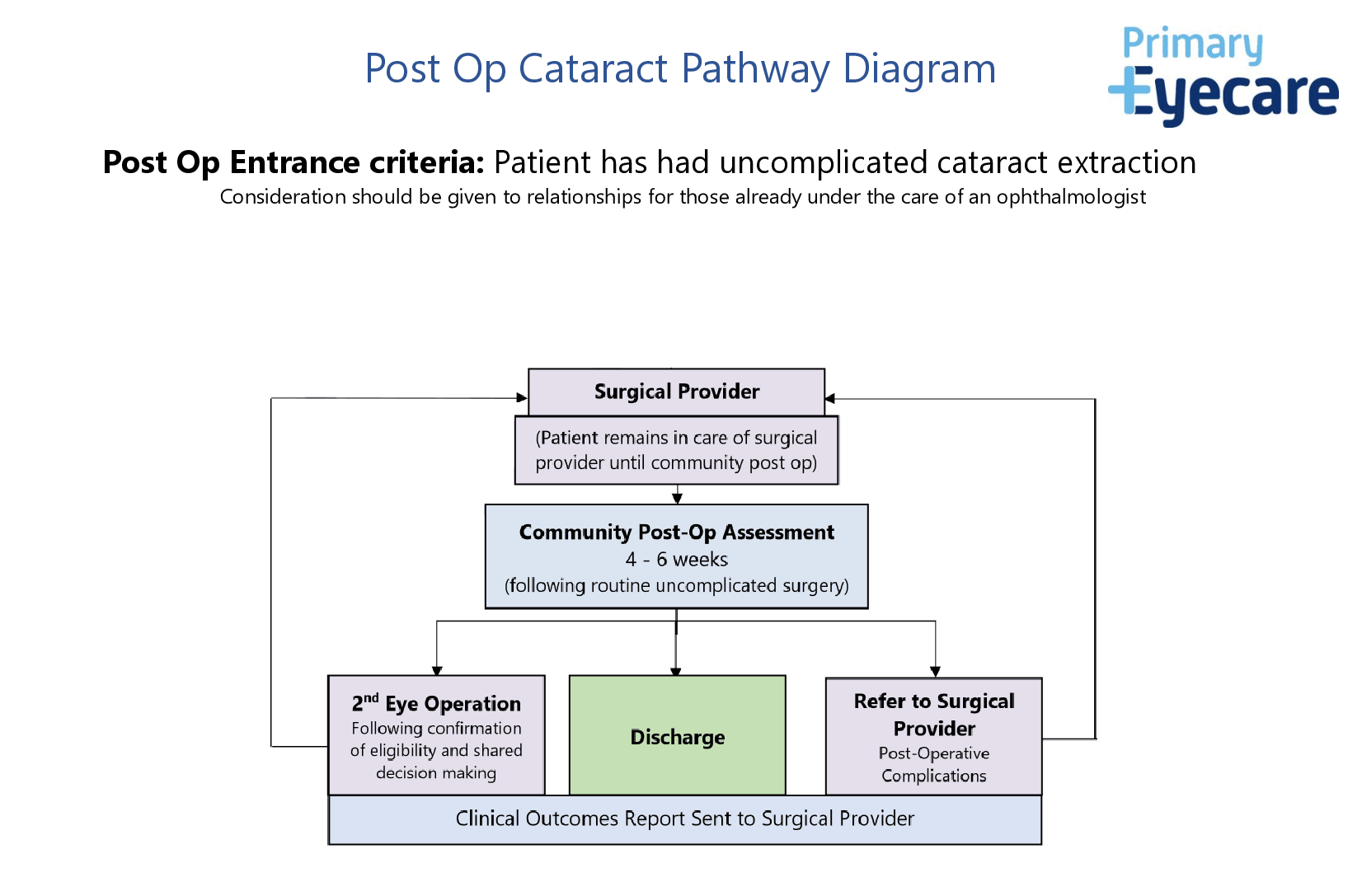
Please Note:
- Please remember to select the outcome “list for 2nd eye surgery” for all post-op cataract patients, who have had 1st eye surgery at UHMB, and who wish to proceed with 2nd eye surgery following from their post-op assessment.
- You will then need to click the red tab and refer the patient to UHMB ROUTINE 2ND EYE REFERRALS FROM POST OP ON OPERA ONLY.
- Please ensure you no longer select “already listed for 2nd eye surgery” as the outcome or the listing may not get picked up and the patient may not get called for their second eye surgery
- A GOS sight test fee can be claimed for both the 1st and 2nd eyes. In the rare event a patient is under 60 and not eligible for a GOS sight test then only the post cat fee can be claimed – practices must not charge these patients for a sight test as service must be free at the point of access.
- Practices cannot add post cat patients to opera themselves. If the patient is not visible on your Opera dashboard, use the blue chat bubble in the first instance to ensure the surgical provider has referred to the correct practice. If Primary Eyecare confirm the patient has not been added by the surgical provider, the practice will need to contact the provider to add them before arranging an appointment using the details below.
Blackpool Teaching Hospital
University Hospital Morecambe Bay
Lancashire Teaching Hospitals
iSight
Fulwood Hall
SpaMedica
CHEC
Optegra
East Lancashire Hospitals
Excel Lampitco (Ophthalmology) Excel.Lampitco@elht.nhs.uk,
Olivia Hanna (Bank Nursing) Olivia.Hanna@elht.nhs.uk,
Hannah White (Ophthalmology Day Case) Hannah.White@elht.nhs.uk,
Jason Goinden (Ophthalmology) Jason.Goinden@elht.nhs.ukNB: Practices must send the request from an NHS.net account when sending patient identifiable data.
Opera help & support for cataract services can be found here
When a patient has their UHMB 1st eye post op cataract episode processed through OPERA and wishes to be referred to have surgery for their second eye, please select the new “UHMB ROUTINE 2ND EYE REFERRALS FROM POST OP ON OPERA ONLY” endpoint to send the referral to.
This will stop a duplicate clinical assessment episode being created in the hospital which would be the case if the normal “UNIVERSITY HOSPITAL MORECAMBE BAY – ROUTINE” endpoint was selected instead.
If a patient has had their first eye surgery some time ago and was discharged without the need to have their second eye surgery at the time, then please create a new referral for their second eye when referral for second eye surgery is indicated and send it to the “UNIVERSITY HOSPITAL MORECAMBE BAY – ROUTINE” endpoint as the patient will need an eye clinic assessment.
Any post operative complications should still be sent via the usual route which would likely be the “UHMB (RLI&FGH) EMERGENCY REFERRALS” endpoint.
Community Urgent Eyecare Services
Practitioners accredited with Primary Eyecare Services can provide CUES using the Opera Platform for any patient registered with a Lancashire & South Cumbria GP.
CUES enables patients to be seen in community optical practice for urgent assessment of acute ocular presentations, thereby reducing the burden on the hospital eye service.
Presenting conditions will typically include :-
- Acute visual changes – flashes and floaters, visual distortion, sudden or transient vision loss/reduction, field loss, and diplopia.
- Ocular discomfort – painful, red, sore, sticky, watery, itchy, dry, or irritated eye(s) or eyelid(s).
- Abrasions and foreign bodies – known history of low velocity, non-penetrating, and nonchemical injury.
- Other presentations requiring urgent clinical investigation but not suitable for GOS and not appropriate for eye casualty.
CUES is not optimal for the following presentations:
- Sudden and sustained loss of vision, or vision loss with malaise
- Chemical or high velocity/penetrating eye injuries
- Post-operative complications from recent eye surgery
- Sudden onset diplopia
- Headaches with no visual symptoms
Patients should be redirected to a more appropriate setting unless,
- they have already been redirected into CUES from elsewhere.
- they are unable to access alternatives within suitable timescale.
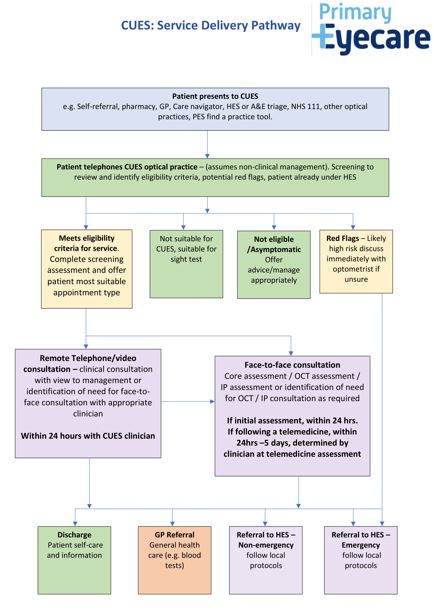
CUES service specification: Here
Opera help & support for CUES can be found here
Please Note:
- There are no age restrictions for CUES
- Please can all CUES practices ensure that they triage CUES patients and add them to OPERA, then look to find an appointment in the system for the patient by ringing round alternative practices. The triaged episode can then be sent on to the practice which will examine the patient.
- OCT can only be claimed for patients with a sudden drop in vision with central distortion and not for any other presentations.
- The CUES fee covers follow up appointments for the same condition for up to 3 months.
Non-accredited practices should use the find a practice site to refer any patient presenting with symptoms suggestive of an urgent eye condition to a nearby participating CUES practice. Please ring the practice first to check for availability.
FIND A PRACTICE
A list of accredited optical practices currently providing the service is available on the Primary Eyecare Website using the ‘Find a Practice’ tool. This shows the most up to date information.
Glaucoma Repeat Readings (GRR)
Practitioners accredited with Primary Eyecare Services (Wopec Glaucoma Level 1) can provide GRR using the Opera Platform for any patient registered with a Lancashire & South Cumbria GP.
GRR service specification: Here
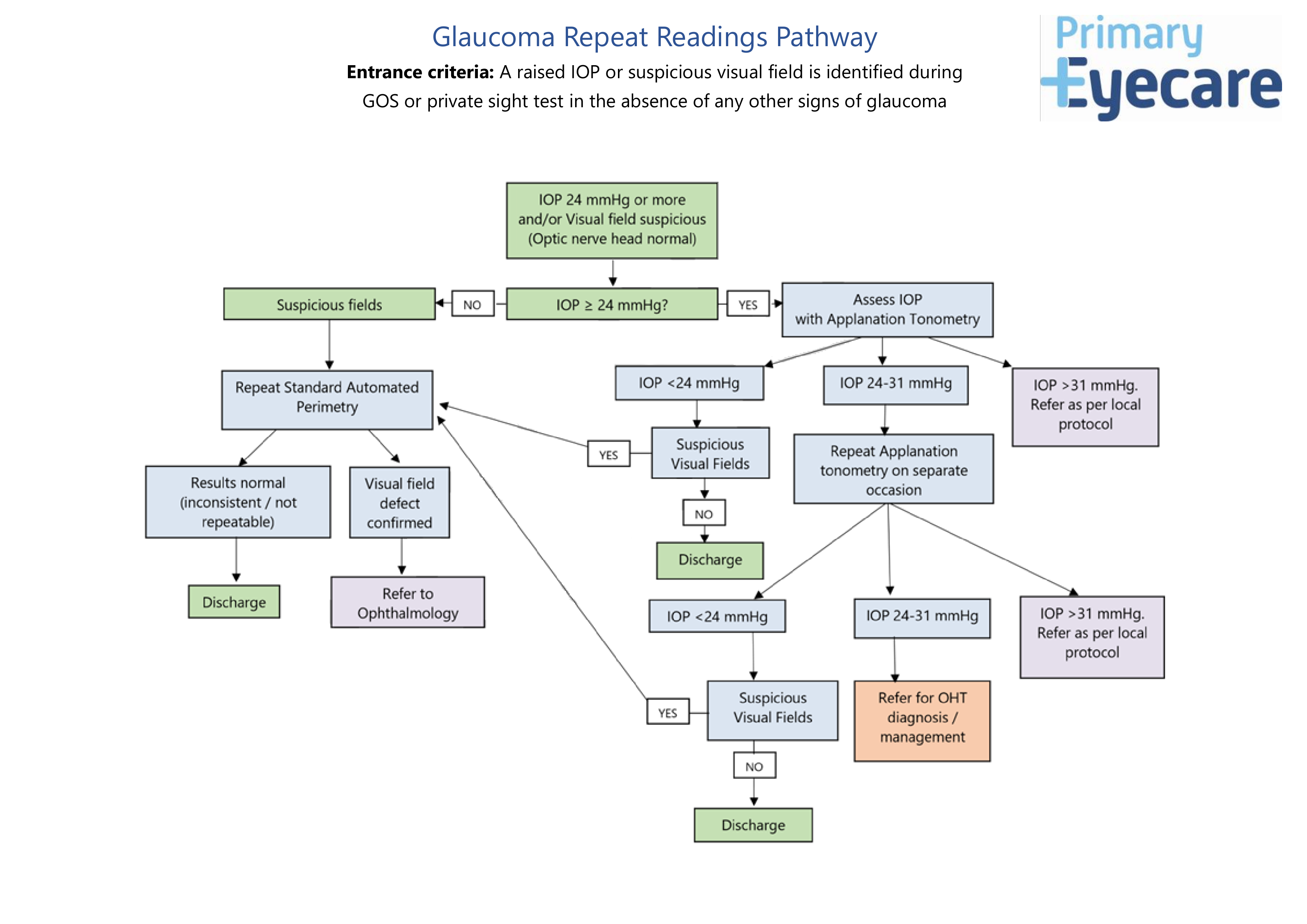
Non participating practices should refer patients with raised IOP and/or suspicious visual fields (but normal optic discs) to an accredited practice on opera by selecting:- primary care services-> GRR -> select accredited practice.
Glaucoma Enhanced Case Finding (GECF/GERS)
Practitioners accredited with Primary Eyecare Services (Wopec Glaucoma Level 2 or higher) can provide GECF/GERS using the Opera Platform for any patient registered with a Lancashire & South Cumbria GP.
GECF/GERS service specification: Here
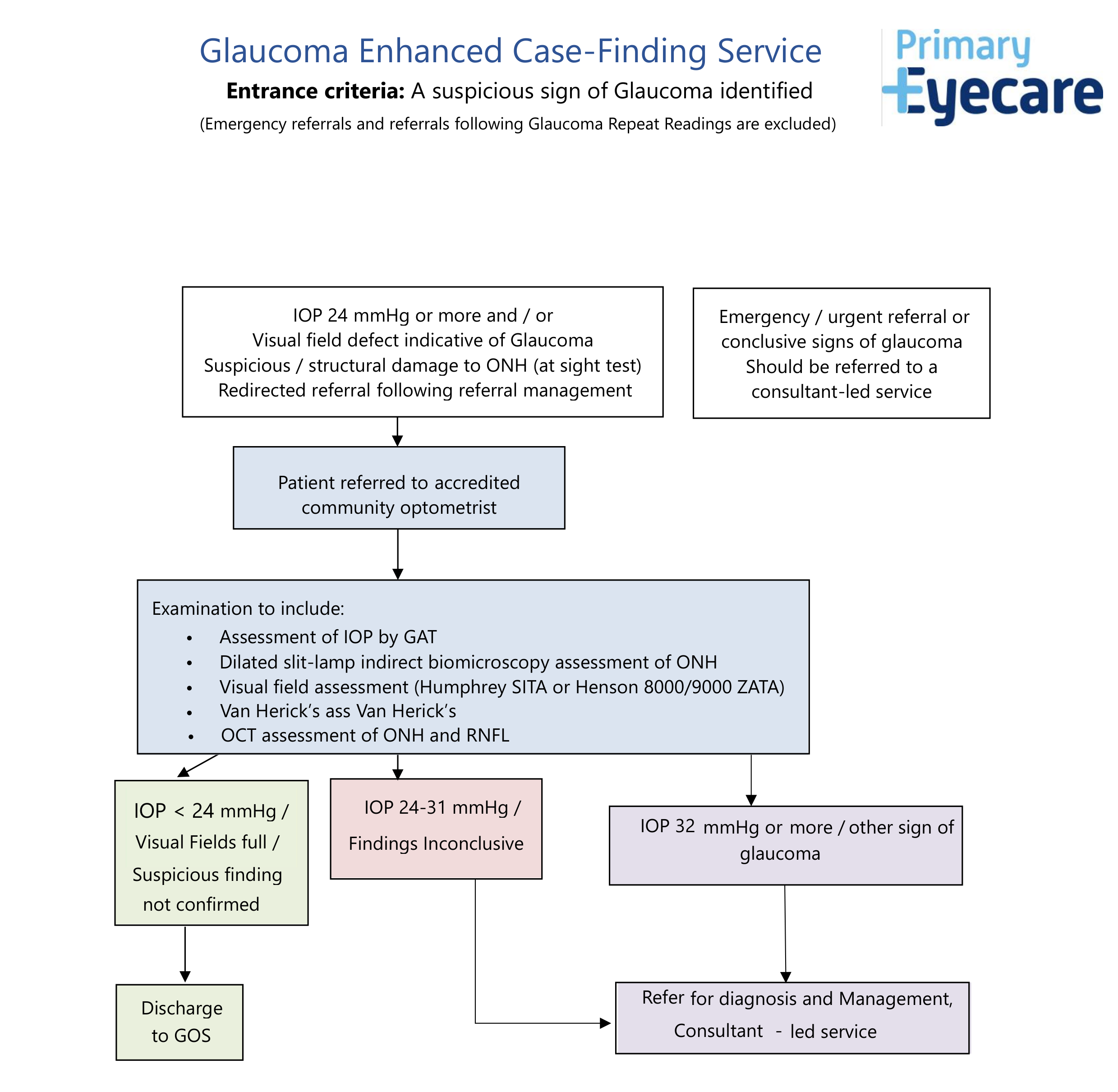
Non participating practices should refer patients with raised IOP and/or suspicious visual fields and/or suspicious optic discs to an accredited practice on opera by selecting:- primary care services-> GECF/GERS -> select accredited practice.
For practices not on Opera please consider onboarding, otherwise, contact an accredited practice then send a GOS18 referral to them via NHS.net, confirming receipt. PLEASE DO NOT TELL PATIENTS TO RING ROUND OR JUST TURN UP. You can find local accredited practices by emailing hello@referrals.support.
Hydroxychloroquine Retinal Monitoring
The RCOphth guidelines¹ regarding retinal monitoring for hydroxychloroquine retinopathy were updated again in December 2020 and no longer recommend baseline ‘screening’.
It is for the drug prescriber, commonly a Rheumatologist, Dermatologist or GP, to determine the patient’s risk and refer to the local ophthalmology department for HCQ monitoring.The need for referral is based on the following:
- Duration of treatment
- Low risk patients require monitoring after 5 years
- High risk patients require monitoring after 1 year
- High risk factors:
- Dose >5mg per kg
- Concomitant tamoxifen use
- Reduced eGFR (less than 60ml/min)
- Taking chloroquine
Local Medical Retina teams need all the information above in any referral. The LOC recommends that Optometrists who consider their patients need to be referred for monitoring write to the drug prescriber requesting consideration of the above clinical detail. If the Optometrist feels that a direct referral is more appropriate it would be helpful to establish that a referral has not already been made by another clinician (eg GP) in order to avoid duplication.
HCQ monitoring in the HES does not replace regular sight testing and will not assess for any other pathology. Refer via the usual channels for all other conditions.Local hospital optometry colleagues may be able to assist with queries:
UHMB: Sophie Grisenthwaite s.grisenthwaite@mbht.nhs.uk¹Royal College of Ophthalmologists Guidance https://www.rcophth.ac.uk/wpcontent/uploads/2020/12/Hydroxychloroquine-and-Chloroquine-Retinopathy-Monitoring-Guideline.pdf
- Duration of treatment
The service should be available to anyone who is recognised by their GP as having a mild, moderate or severe learning disability who are on a local learning disability register. The patient must be registered with a GP practice in the Lancashire and South Cumbria area, or be a Lancashire & South Cumbria resident and not registered with a GP anywhere.
This commissioned service is a service with reasonable adjustments for someone who would not be able to use a standard eye test.
This includes:
- pre-appointment visits,
- completion of a functional vision assessment if needed,
- longer appointment time with an accredited practitioner in learning disabilities and autism
- feedback forms completed by the optometrist.
The results of the examination are reported using the agreed appropriate format. WOPEC accreditation is required to provide this service.
The orthoptist team at Blackpool Victoria Hospital are keen to support optometrists and can be contacted at bfwh.orthoptics@nhs.net
Easy Eyecare service specification: Here
Opera help & support for Easy Eyecare can be found here
FIND A PRACTICE
A list of accredited optical practices currently providing the service is available on the Primary Eyecare Website using the ‘Find a Practice’ tool. This shows the most up to date information.
If you require any further information or have any queries regarding the service, please contact Primary Eyecare Services on hello@referral.support and a member of the team will be in touch.
Practitioners accredited with Primary Eyecare Services (Wopec Low Vision) can provide this service using the Opera Platform for any patient registered with a Lancashire & South Cumbria GP.
Patients may be referred in by another optical practitioner, GP, Hospital Eye Service (HES), social services, third sector etc or may self-refer.
Sight Loss Directory : January 2026 updated version – See annex listing all the Tier 1 ophthalmology sub-contractors who provide the community Low Vision service.
Low Vision service specification: Here
Note: the 6 week telephone follow up can be done by admin staff and not a LV practitioner.
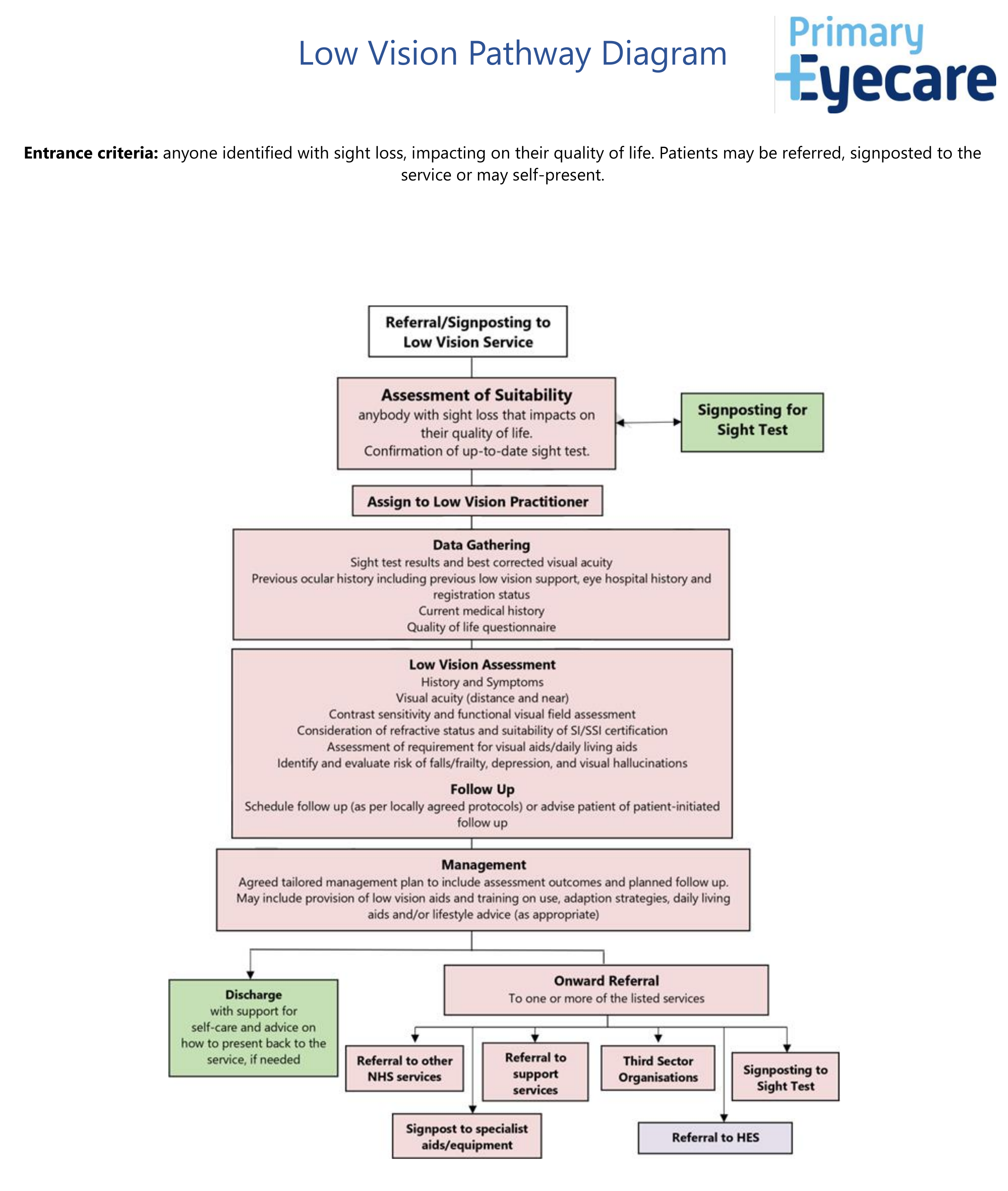
Opera help & support for Low Vision can be found here
FIND A PRACTICE
A list of accredited optical practices currently providing the service is available on the Primary Eyecare Website using the ‘Find a Practice’ tool. This shows the most up to date information.
If you require any further information or have any queries regarding the service, please contact Primary Eyecare Services on hello@referral.support and a member of the team will be in touch.The following page details the Low Vision, ECLO, Voluntary and Statutory services available in Morecambe Bay.
NONE OF THESE RESOURCES REQUIRE SOMEONE TO BE REGISTERED SIGHT IMPAIRED / SEVERELY SIGHT IMPAIRED IN ORDER TO RECEIVE ASSISTANCE.
Low Vision Service: A clinically informed evaluation of the impact of sight loss on an individual and identification of a variety of strategies to meet the resulting challenges. Making best use of remaining vision using magnifiers, lighting, visual aids, and sight training strategies.
Eye Clinic Liaison Officer (ECLO): The link between primary and secondary care clinical services and non-clinical support services for people with sight loss. ECLO’s provide emotional support, practical advice, impartial information, guidance, and advocacy and connect with other community resources.
Local Council: Statutory support and rehabilitation via Rehabilitation Officers for the Visually Impaired (ROVIs).
Voluntary & Community Organisations: Charities and other groups that provide a wide range of support services.
Barrow-in-Furness & Grange-over-Sands
Community Low Vision Service
Lead community provider: Primary Eyecare Services
Available through participating optical practices, andVision Support Barrow & District (VSBD)
Primary care ophthalmic referrals via OPERA
Website: vsbd.org.uk
Email: info@vsbd.org.uk
Phone: 01229 440 556
Location: VSBD Vision Support Centre 67-69 Cavendish Street, Barrow in Furness, LA14 1QD Also available at Peninsula Medical Centre Kents Bank Road, Grange-over-Sands, LA11 7DJRos Killip (Dispensing Optician)
Paediatric Low Vision
- Contact ‘Sight Advice South Lakes’ (Kendal), or ECLO
- Ensure patient is known to paediatric ophthalmology
ECLO
Location: VSBD Vision Support Centre – see above.
- Adele Williams (VSBD)
Email: adele.williams@vsbd.org.uk
Local Voluntary/Community
-
Vision Support Barrow and District (VSBD) vsbd.org.uk
Local Council – Lancashire County Council Sensory Impairment Team
Westmorland & Furness Council Adult Social Care customerservicesASC@westmorlandandfurness.gov.uk
Tel: 0300 373 3301
ROVI: Ali.Hassan@WestmorlandandFurness.gov.uk
ROVI: Carol.Prescott@WestmorlandandFurness.gov.ukKendal Area
Community Low Vision Service
Lead community provider: Primary Eyecare Services
Available through participating optical practices, and
Sight Advice South Lakes
Primary care ophthalmic referrals via OPERA
Web: sightadvice.org.uk
Email: info@sightadviceorg.uk
Phone: 01539 769055
Location: The Bradbury Centre 116 Highgate, Kendal, LA9 4HETim Ward and Jackie Bateman (SASL)
Paediatric Low Vision
- Contact ‘Sight Advice South Lakes’ (Kendal), or ECLO
- Ensure patient is known to paediatric ophthalmology
ECLO
Location: Westmorland General Hospital or SASL – see above.
- Sarah Stoddard (SASL)
Email: sarah@sightadvice.org.uk - Tim Ward (SASL)
Email: tim@sightadvice.org.uk
Local Voluntary/Community
-
Sight Advice South Lakes – see above sightadvice.org.uk
Local Council – Lancashire County Council Sensory Impairment Team
Westmorland & Furness Council Adult Social Care
Website: customerservicesASC@westmorlandandfurness.gov.uk
Phone: 0300 373 3301
ROVI: Ali.Hassan@WestmorlandandFurness.gov.uk
ROVI: Carol.Prescott@WestmorlandandFurness.gov.ukLancaster & Morecambe
Community Low Vision Service
Lead community provider: Primary Eyecare Services
Available through participating optical practices, and
Galloways Society (Morecambe)
Primary care ophthalmic referrals via OPERA
Web: galloways.org.uk
Phone: 01772 744 148
Location: ‘Brew Me Sunshine’, 12 Victoria Street Morecambe, LA4 4AHGlen Sheader – Low Vision Lead
Paediatric Low Vision
- Contact Galloways as above, or ECLO
- Ensure patient is known to paediatric ophthalmology
ECLO
Location: Royal Lancaster Infirmary + Galloways – see above
- Molly Vaughan-Wallis (Galloways)
Email: molly.vaughan-wallis@nhs.net, molly.vaughanwallis@galloways.org.uk
Local Voluntary/Community
-
Galloways – see above Galloways.org.uk
Local Council – Lancashire County Council Sensory Impairment Team
Lancashire County Council Sensory Impairment Team
Tel: 0300 123 6720
Website: csc.acscustomerservices@lancashire.gov.uk
Referral form: needs assessment to aid independent living. Note: Patients do not need to be registered sight impaired to be entitled to an assessment from the council.National Charities
Sightline
Charity based in NW England offering a free telephone-based befriending service designed to reduce loneliness and isolation for anyone living with a visual impairment.
Guide Dogs
Support to live actively, independently, and well with sight loss
RNIB
Inspiring people with sight loss to transform their personal experience
Macular Society
There is no need to face macular disease alone
Glaucoma UK
Supporting people to live well with glaucoma
Blind Veterans
Helping blind ex-Service people lead independent and fulfilling lives
Deaf Blind UK
Showing people that there can be a life beyond deafblindness
SeeAbility
Supporting people who have learning disabilities or autism
Sense
For everyone living with complex disabilities